

Making volunteering easier and more accessible post covid

CONTEXT
HCDE 318: Intro to User Centered Design
DURATION
10 weeks
Winter 2022
TOOLS
Figma
TEAM
Kristie Lee
Annie Lu
Abbie Sawyer
Daphanie Chan
PROBLEM
Since Covid, our lives have changed drastically and apps and websites pre-Covi may not be tailored to the present. Make a website or app that solves a problem that has arisen from Covid
SOLUTION
Our website provides a service to post and browse volunteering opportunities. What makes us stand out is our "quickGiv" feature. Since quarantine, time seems to move faster as people have more and more to do. "quickGiv" features an option to find short and quick volunteering gigs.
Final Design
*keep scrolling for our design process
Our final design came from an in-depth design process where we collaborated as a team with different research perspectives to fit the needs of our target demographics. We put our users first to design our web-based platform.
RESEARCH
Key Insights
These insights were gathered through our interviews with those with volunteering experience
-
Many of these nonprofit volunteer organizations lack adequate advertisement exposure to attract more volunteers to help out in the midst of the pandemic, which leads to downsizing the organization and its efforts.
-
It will be very helpful for the volunteers to see descriptions of the duties, the environment, and situations they will be placed in.
-
In-person contact during COVID-19 may make some people wary, so finding alternative methods of allowing volunteers to contribute is critical during times like these.
-
There are not that many websites to find volunteer opportunities, especially since it’s not a money-heavy industry.
-
Creating an app/website that is very user-friendly and easy to navigate for those who aren’t tech-savvy is crucial in order to target the valuable, older generation that makes up a large population of volunteers.
Personas
We developed personas that combined our interviewees, This gave us a specific persona to design our final web page for

Our younger persona, Paige, who makes up a large majority of volunteers
Our older persona, Cindy, who also makes up a large majority of volunteers

User Journey Map
Our user journey map follows our key user's journey through our projected product, noting her emotional response through the process

How can we make the process before volunteering most efficient and highly functional for both the volunteering organizer and the volunteer?
Through combining our research above and comparative and inclusive design analysis, we compiled key design goals for our website.
-
Finding a volunteering opportunity that caters to the user's interests is easy, intuitive, and conceptual
-
Chatting between the volunteer and volunteering organization is simple to navigate to
-
Uploading a volunteering opportunity is intuitive and also customizable
DESIGN
Storyboard
Storyboarding was a great way for our team to illustrate the many different features we wanted to include in our final product. It also helps our team brainstorm and prioritize the different features we should include.

Information Architecture
Our informational architecture allows us to map out what features we include and the pathways that each feature brings us through. This helps organize our work before our low-fidelity wireframe

Wireframing
Our team opened Figma and put together a low-fidelity wire frame of our final website. This encouraged us to only focus on the functions and not get distracted by colors and other design features.
We realized here that we needed to shorten the amount of features that we had as we were dealing with two types of users. This included the volunteer and volunteer organization. We simplified our functions and focused on making the usability of the few we kept. optimal.

Low-Fi Wireframes

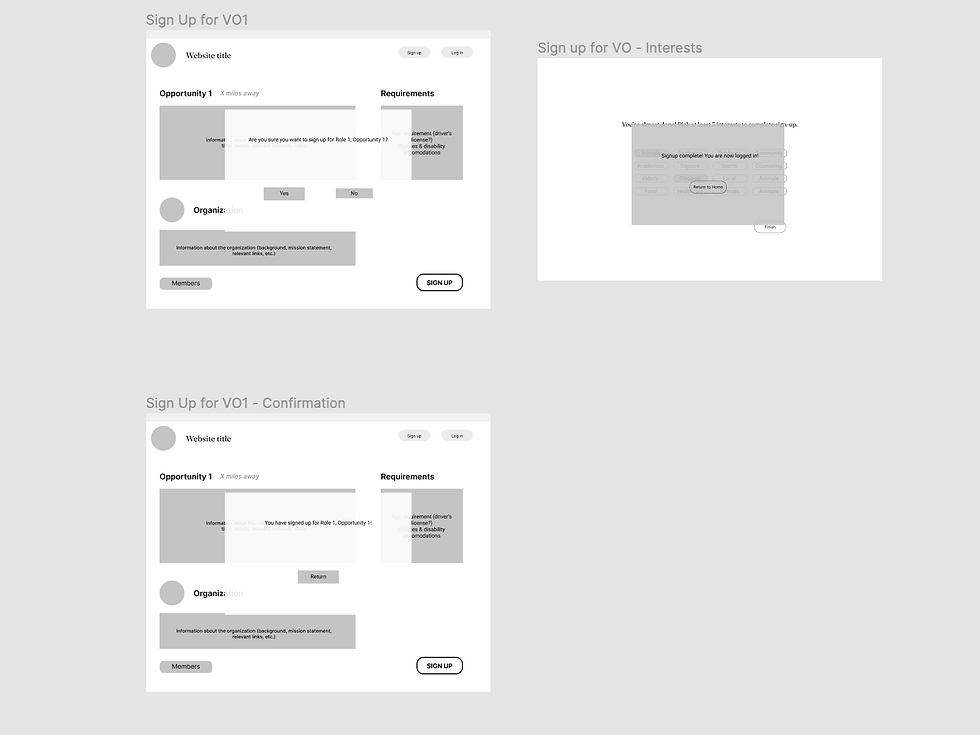
Low-Fi Wireframes
Final Design!
We made it! Our final design came from an in-depth design process where we collaborated as a team with different research perspectives to fit the needs of our target demographics. We put our users first to design our web-based platform.